.png)
Just Counting Pennies


Better pick up that shiny penny on the ground. It could be worth more than you think, and not because of the 2.5% copper it contains.
What caused the demise of the Lincoln-toting coin, and how will it leave a hole in your pocket? This decision costs most consumers money every day. It also makes big businesses large amounts of tax-free dollars monthly. Stay tuned to find out how.
There are three major factors contributing to the penny’s removal from the United
States coin crop. First and most importantly, in November 2025, the U.S. Mint halted production of the penny. The reason was that the one-cent coin was costing nearly four cents to produce.
The second factor is decreased circulation. The commonly termed “Penny Shortage” is a result of increased use of credit and debit cards. This has left the penny stuck in household jars, piggy banks, car cup holders, or abandoned on the pavement. Some might say the penny has been doomed for a long time, as it is the most commonly found coin on the ground. Its low value makes it not even worth bending over to pick up.
The last factor is a policy change by the Federal Reserve. The Reserve restricted or paused the acceptance and redistribution of existing pennies. This makes it nearly impossible for local banks and retailers to restock the penny.
In response to these three factors, many retailers are adopting “exact change” policies. That means pay digitally by credit card or have the exact amount. Most of us would say this is not a big deal. We’ve become accustomed to paying in some form other than cash. Here are some interesting numbers that could start you thinking. Four to six percent of Americans (15-16 million people) don’t have access to a debit card. Fifteen to sixteen percent of American households (not people) don’t have access to a credit card. Roughly 25% don’t use digital payment methods. These numbers do not account for minors and unregistered individuals, who largely make cash purchases. Admittedly, the three factors above did not cause these numbers. They may not even affect the percentages. What they have caused is more money being taken from people who live on the financial edge.

You may not be in any of these situations, but I assure you, you are losing money. Incidentally, the farther detached from these situations you may be, the more likely you are to not even be aware you could be losing money.
This brings us back to the “hole in your pocket.” While U.S. agencies have not made any formal rules or determinations about what happens without the penny, large corporations such as big-box retailers, national fast-food chains, and the like have found a windfall of tax-free money. Over the last month, I have visited a mix of national big-box stores, national fast-food chains, and “mom and pop” retail establishments. In each instance, I bought items and paid with cash. Over 90% of the stores rounded up the cost of my items to the nearest nickel. This rounding up is done manually. That means the store's computerized register has no record of the upcharge.
The average box store takes in $150,000 to $300,000 of revenue daily. At $ 0.01 per day per upcharge, using just 5% of the people who pay cash, that’s $75 to $150 in untaxed money per day per store. A single store can generate $27,375 to $54,750 per year in untaxed income. When you add up all the stores in a chain, the total is staggering and currently undetermined. Please take into consideration the following two factors.
1. These numbers are extrapolated at only 5% and at $0.01.
2. These sums do not account for situations when rounding up includes the $0.02 to $0.04 range. If it were possible to add those calculations, the totals may be significantly higher.
What does that mean to the consumer? Figure out how many times you pay with cash and are literally short-changed. It could be thousands of dollars in hard-earned money, leaving your pocket without you even realizing it. In case you’re wondering, you have the right to ask for the correct change or to have the establishment swing the extra pennies in your favor. They can refuse to sell you the item(s).
Stores should post signage regarding their “Penny Shortage” policy.
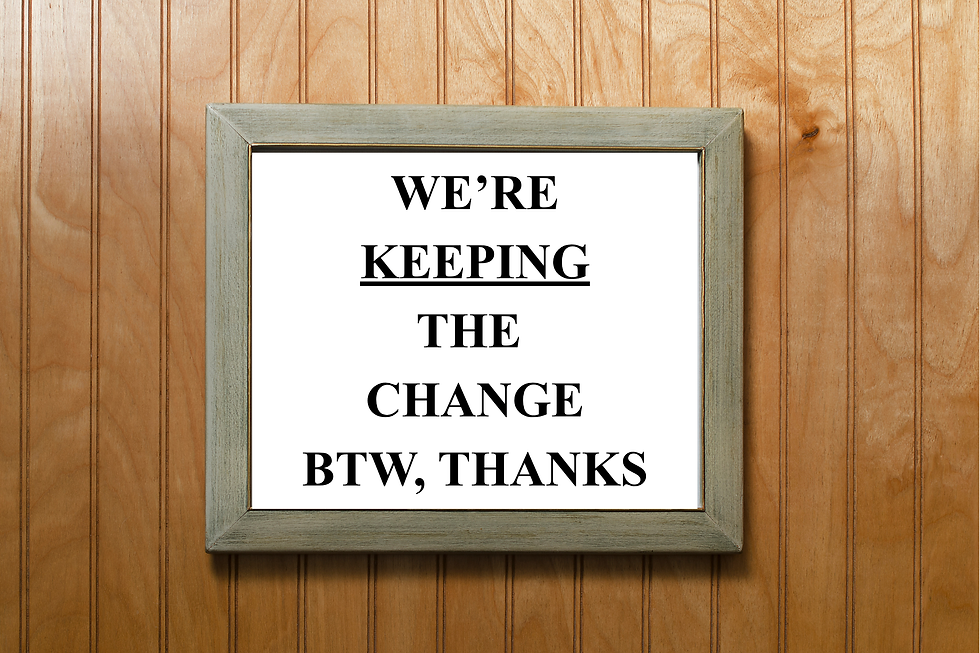
I have several suggestions to help remedy this situation, but for now, I’ll just be counting pennies.
Please feel free to share your thoughts and ideas on what may someday be called PennyGate .


nice post